
Cookie banners are everywhere, but a lot of business owners implement them without really understanding whether they are legally required or just following what they see on other sites. The honest answer depends on where your visitors come from and what your cookies actually do. Here is how to know for sure: does my website need a cookie consent banner?
What Is a Cookie Consent Banner and Why Does It Exist?
A cookie consent banner is the popup or bar that appears when someone visits your website asking them to accept, reject, or manage cookies. It exists because privacy laws in Europe and the UK require websites to get user consent before placing non-essential cookies on their device.
Cookies are small files your website places in a visitor’s browser. Some are essential, like the cookie that keeps a user logged in. Others are not essential, like the Google Analytics cookie that tracks what pages they visit or the Facebook Pixel that follows them across the web for retargeting.
Does My Website Need a Cookie Consent Banner Under US Law?
If all your visitors are based in the US and you are not subject to California law, there is no federal US law that specifically requires a cookie consent banner. However:
- If you have California visitors, the CCPA requires you to give users the right to opt out of the sale of their data, which effectively requires disclosing and managing cookie-based tracking
- The FTC requires honest disclosure of data collection practices, which cookie banners help satisfy
- Google and Meta both require a privacy policy and disclosure of tracking in their platform terms if you run ads
The CCPA requirements apply to any business that meets certain thresholds and has California customers, which covers most US businesses with a public website.
Does My Website Need a Cookie Consent Banner Under GDPR?
Yes, if any of your visitors are from the EU or UK. GDPR and the UK’s ICO guidance both require explicit, informed consent before placing non-essential cookies. That means:
- The banner must appear before any non-essential cookies are set, not after
- Rejecting cookies must be as easy as accepting them, no dark patterns
- You cannot pre-tick consent boxes
- Users must be able to change their mind and withdraw consent at any time
If you have a global website and do not specifically block EU traffic, GDPR applies to you. Most businesses do not block EU traffic, so GDPR applies to most businesses with a public website.
What Types of Cookies Require Consent?
Not all cookies need consent. Here is the breakdown:
- Essential cookies — no consent needed. These keep your site functional: login sessions, shopping cart contents, security cookies
- Analytics cookies — consent required. Google Analytics, Hotjar, and similar tools that track user behavior need consent under GDPR
- Marketing cookies — consent required. Facebook Pixel, Google Ads remarketing, and any retargeting tool absolutely requires consent
- Preference cookies — usually requires consent. Cookies that remember a user’s language or font size technically need consent in most jurisdictions
What Happens If You Skip the Cookie Consent Banner?
Under GDPR, fines can reach 4 percent of global annual revenue. The ICO has fined businesses in the UK for non-compliant cookie implementations. Beyond fines, ad platforms can suspend your account if they find you collecting consent-required data without disclosure.
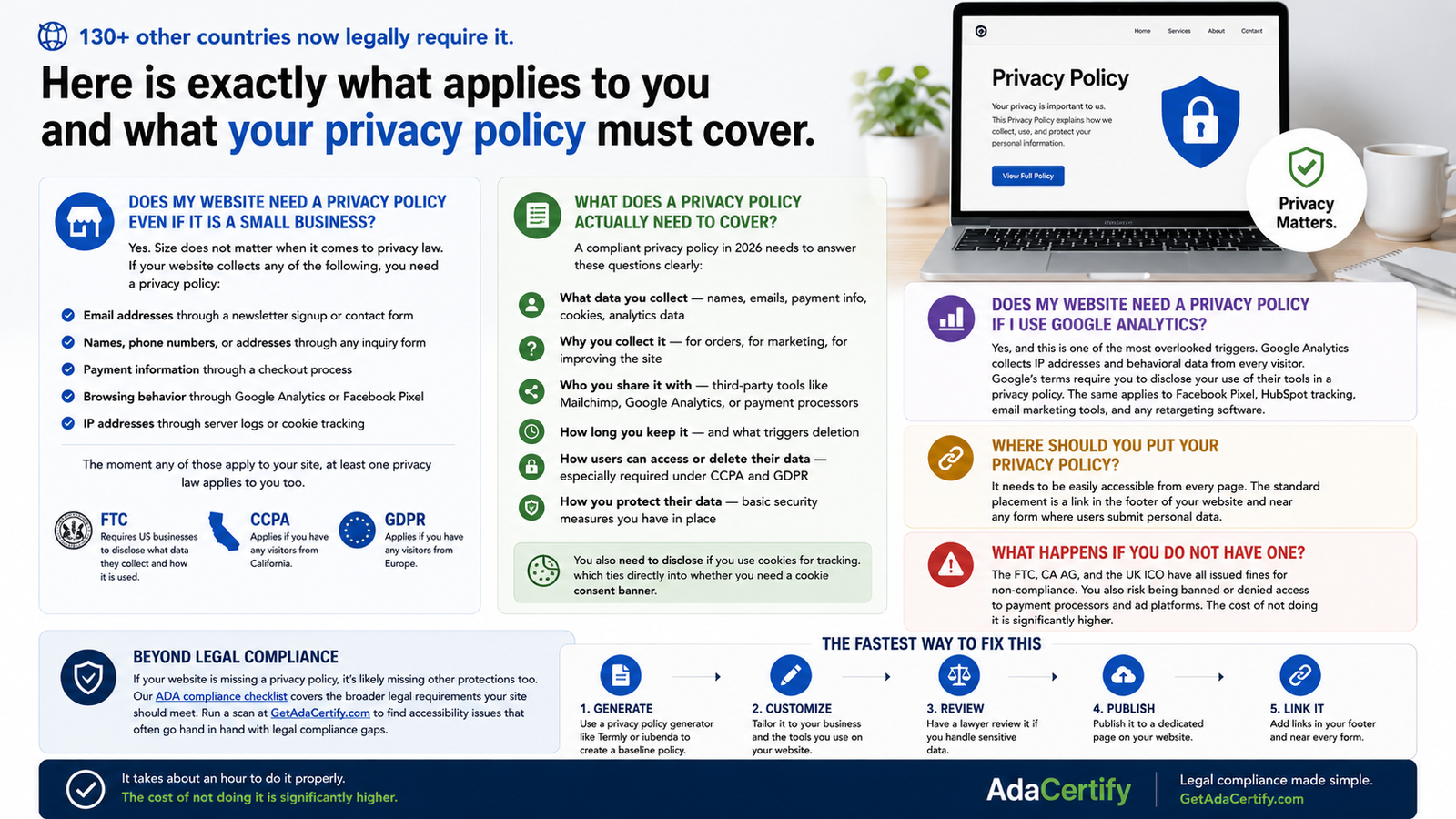
Cookie compliance is one piece of a broader website legal picture. The related piece is your privacy policy, which we covered in our post on whether your website needs a privacy policy. And if your site also has accessibility gaps, a scan at GetAdaCertify will surface those issues alongside your compliance review.
The Fastest Way to Get Compliant
Use a consent management platform like Cookiebot, CookieYes, or OneTrust. These tools automatically scan your site for cookies, categorize them, and generate a compliant banner. Most have free tiers for small sites. Set it up properly once and it handles ongoing compliance automatically as your cookie inventory changes.