
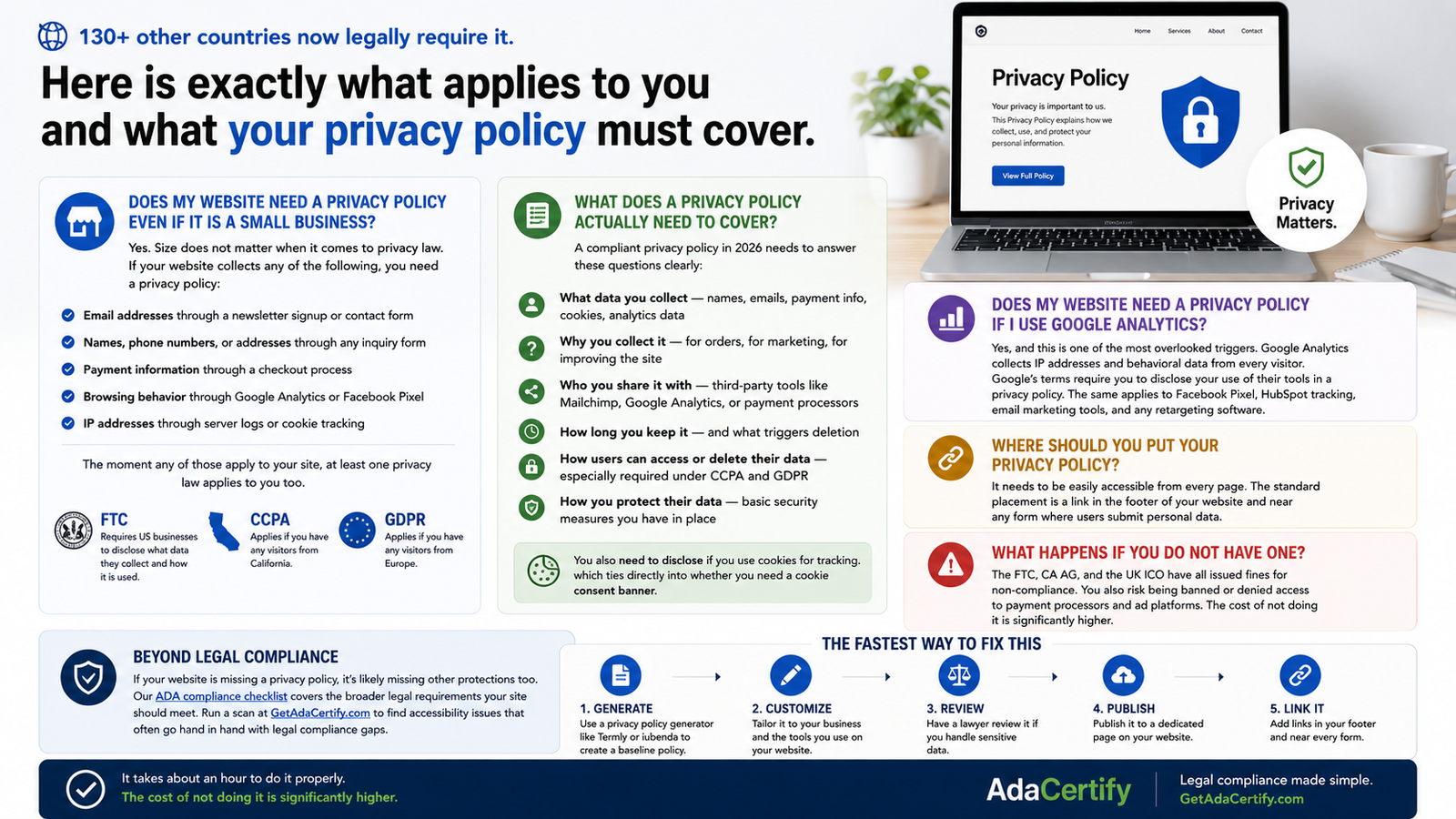
If you collect any information from visitors on your website, even just an email address, you almost certainly need a privacy policy. Not because it is nice to have, but because US law, EU law, and over 130 other countries now legally require it. Here is exactly what applies to you and what your privacy policy must cover.
Does My Website Need a Privacy Policy Even If It Is a Small Business?
Yes. Size does not matter when it comes to privacy law. If your website collects any of the following, you need a privacy policy:
- Email addresses through a newsletter signup or contact form
- Names, phone numbers, or addresses through any inquiry form
- Payment information through a checkout process
- Browsing behavior through Google Analytics or Facebook Pixel
- IP addresses through server logs or cookie tracking
The moment any of those apply to your site, at least one privacy law applies to you too. The FTC requires US businesses to disclose what data they collect and how it is used. If you have any visitors from California, the CCPA applies. If you have visitors from Europe, GDPR applies.
What Does a Privacy Policy Actually Need to Cover?
A compliant privacy policy for a business website in 2026 needs to answer these questions clearly:
- What data you collect — names, emails, payment info, cookies, analytics data
- Why you collect it — for orders, for marketing, for improving the site
- Who you share it with — third-party tools like Mailchimp, Google Analytics, or payment processors
- How long you keep it — and what triggers deletion
- How users can access or delete their data — especially required under CCPA and GDPR
- How you protect their data — basic security measures you have in place
You also need to disclose if you use cookies for tracking, which ties directly into whether you need a cookie consent banner as well. We covered that in detail in our post on what legal pages every business website needs.
Does My Website Need a Privacy Policy If I Use Google Analytics?
Yes, and this is one of the most overlooked triggers. Google Analytics collects IP addresses and behavioral data from every visitor. Google’s own terms of service require you to have a privacy policy in place that discloses your use of their analytics tools. If you do not have one and you are running Google Analytics, you are already in violation of Google’s terms, not just the law.
The same applies to Facebook Pixel, HubSpot tracking, email marketing tools that track open rates, and any retargeting software.
Where Should You Put Your Privacy Policy?
It needs to be easily accessible from every page. The standard placement is a link in the footer of your website. Most privacy laws do not specify exact placement but do require it to be clearly visible before a user submits any personal data, which means it should also be linked near any form on your site.
What Happens If You Do Not Have One?
The risks are real. The FTC has fined companies for deceptive data practices. California’s AG office has issued enforcement actions under CCPA. The UK’s ICO has fined businesses under GDPR for exactly this. And beyond regulatory risk, many payment processors and ad platforms require a privacy policy before approving your account.
Beyond legal compliance, if your website is missing a privacy policy, it is also likely missing other protections. The ADA compliance checklist we published covers the broader set of legal requirements your site should meet, and a scan at GetAdaCertify can flag accessibility issues that often go hand in hand with legal compliance gaps.
The Fastest Way to Fix This
Use a privacy policy generator like Termly or iubenda to create a baseline policy tailored to your site and the tools you use. Customize it for accuracy, have a lawyer review it if you handle sensitive data, publish it to a dedicated page on your site, and link it from your footer and every form.
It takes about an hour to do it properly. The cost of not doing it is significantly higher.